
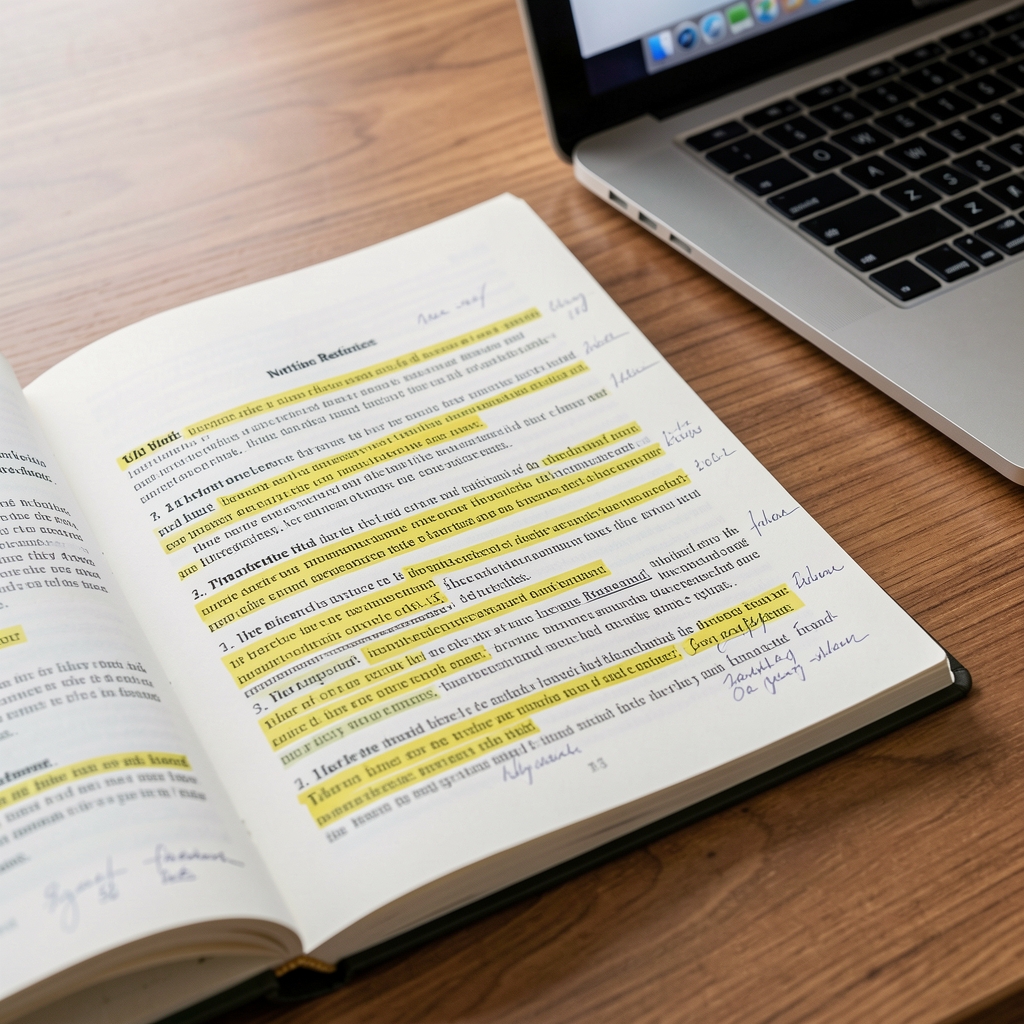
The editorial process at Talone is not a marketing claim. It is a documented sequence of steps that every piece of content passes through before publication. This page describes that sequence in full.
Each entry begins with a systematic identification of available published research on the topic. Primary sources — peer-reviewed journals in nutritional science, movement research, and wellness practice — are preferred over secondary or tertiary reporting. When peer-reviewed research is not available, guidance from qualified wellness professionals with documented expertise is used and identified explicitly as practitioner guidance rather than published research.
Sources are logged in an internal reference document before drafting begins. The total source list for a standard entry is a minimum of three independent references. For complex topics in body composition awareness or nutritional balance, five or more sources are required before drafting is authorised.
Drafts are written by the Talone editorial team in a register that is precise but accessible — technical where the subject demands it, but never obscured by unnecessary jargon. The target reader is a literate, motivated man who wants to understand the reasoning behind a recommendation, not merely be told what to do.
All claims are tagged with their source in the draft document. Claims that cannot be tagged at drafting stage are either researched further or removed. The distinction between observed evidence and working hypothesis is preserved in the final text — readers are always informed of the strength of the evidence underlying a recommendation.
Every draft is passed to a qualified nutrition professional for review before publication. The reviewer is independent of the drafting process — they receive the draft and the source log simultaneously, and their task is to identify any claim that overstates the evidence, any recommendation that would be unsuitable for the stated audience, and any omission that materially affects the accuracy of the entry.
Reviewer credentials are held on file at the Talone editorial office. Reviewer names are not published on the site for privacy reasons, but the review process is auditable on request for professional or institutional enquirers. This step typically takes three to five business days.
Reviewer feedback is incorporated in full. There is no negotiation — if the reviewer identifies a claim as overstated, the claim is either rewritten to accurately reflect the evidence or removed entirely. Entries that require substantive revision are returned to the review phase, not accelerated to publication on a revised timeline.
Minor revisions — clarifications of phrasing, improved referencing, added context — are handled by the editorial team without a second full review. Substantive changes that affect the meaning or safety of a recommendation always trigger a second specialist review cycle before the revision cycle is closed.
Ingredient profiles referenced in Talone's nutritional guidance are selected based on published nutritional research and undergo independent batch verification for quality and labelling accuracy. Active ingredients sourced for any affiliated product recommendations are verified with certificates of composition from documented suppliers whose facilities maintain food-grade processing standards.
For content entries that reference specific nutritional values — micronutrient quantities, energy density figures, recommended daily intake levels — values are cross-checked against current guidance from the Indonesian Ministry of Health and international nutritional reference databases before final sign-off.
Published entries receive a version number and a publication date. They are archived in the internal source document with the full review history attached. When new evidence emerges that materially changes a published recommendation, the entry is updated, the revision is noted at the entry level, and the version number is incremented. No entry is silently changed.
The full archive is reviewed quarterly for accuracy against current nutritional guidance. Entries that are no longer supported by current research are either updated or retired. Retired entries are marked as archived rather than deleted, so that the record of what was published — and when — remains accessible to researchers and readers with a historical interest in the resource.
Published in indexed nutritional science, exercise physiology, or public health journals. Preference for studies with clear methodology, adequate sample size, and independent replication.
Registered nutritionists, qualified fitness professionals, and wellness practitioners with demonstrable, documented expertise in the relevant sub-field. Credential verification is mandatory before sourcing.
Indonesian Ministry of Health reference values and WHO nutritional guidance are used for baseline nutritional parameters and recommended intake figures.
Brand-funded research without independent replication. Testimonial-based claims. Unverifiable online sources. Content produced with a commercial interest in the subject of the entry.
The minimum timeline from research initiation to publication is fourteen days. Most entries take three to four weeks, accounting for the review and revision cycle. Complex entries on topics with a large and contested research base — such as detailed body composition guidance — can take six to eight weeks.
The full archive is reviewed quarterly. When new research materially changes a recommendation, the entry is updated, the revision noted, and the version number incremented. Entries no longer supported by current research are marked as archived — not deleted — so the historical record remains intact.
Talone is an independent wellness resource focused on everyday nutrition and active lifestyle practices for men. The content is not affiliated with any governmental or institutional body, and Talone does not receive commercial funding from supplement brands, fitness equipment manufacturers, or any entity with a product interest in the content published here.
Source documentation is available to qualified professional or institutional enquirers on written request via the contact form. Casual reader requests for individual source lists are handled at editorial discretion — most entries include in-text citations that provide sufficient reference for independent verification.